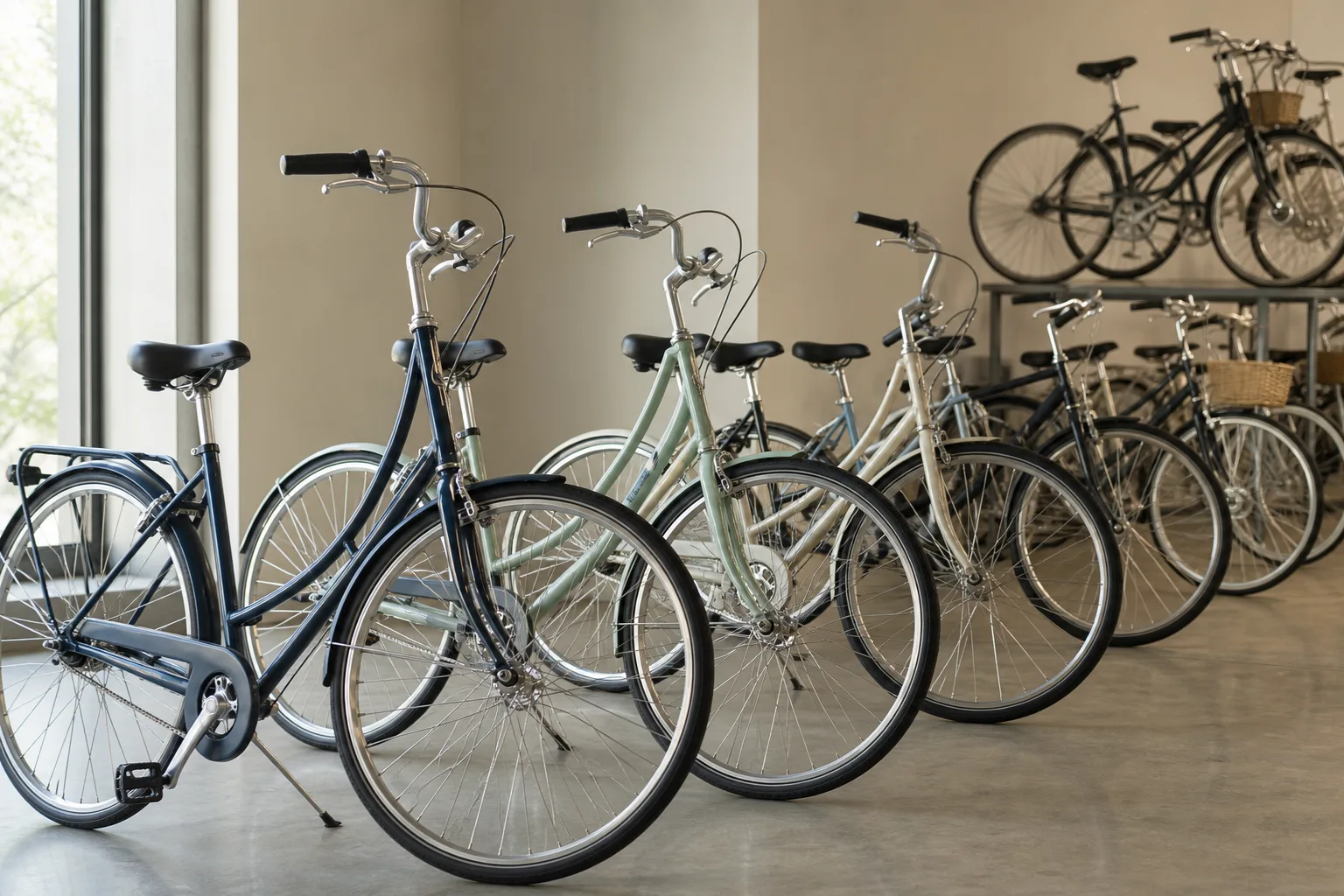
The category has a shape, even if the labels on the shop floor are inconsistent. An upright, cushioned bicycle sits you close to vertical, with the bars at or above saddle height, a seat tube laid back far enough that your hips open, tires wide enough to run soft, and a saddle with some kind of give built into it. A hybrid does most of this except the last two, and leans you forward. A cruiser goes further upright, then gives up gears and brakes you would want on any grade. The differences matter more than the marketing does.
The four things that genuinely change how an hour feels
Bar height and reach come first, because they decide how much of your body weight lands on your hands. Move the grips up two inches and back one, and pressure shifts off the wrists and onto the seat bones, which are built for it. Seat tube angle comes second: a slacker tube puts your hips behind the cranks, which lets you sit back into the saddle instead of perching on its nose. Tire width comes third, because width is what lets you drop pressure. Gear range comes fourth, and it is the one people discover late.
Those four are structural. You can adjust bar height a little with a taller stem or a riser bar, and you can change tires within whatever the frame and fork will clear, but you cannot move the seat tube, and you cannot bolt a wider range onto a drivetrain that was not built for it without spending real money. That is why the frame decision is the expensive one and the accessory decisions are not. Everything else on the bike is comparatively cheap to change later, which is exactly why it should not drive the purchase.
What tends to look like comfort and mostly is not
A thick gel cover on a narrow saddle spreads load onto soft tissue rather than bone, and after forty minutes most riders would rather have had a firmer, wider saddle with the correct spacing for their pelvis. A short-travel suspension fork on a bike that will only see pavement adds weight, adds maintenance, and absorbs some of your pedaling. Chunky knobby tires look capable and roll slowly on asphalt while transmitting more buzz than a smooth casing at the same width. Full chain guards, swept fenders and a rack are all useful, but none of them is comfort.
The honest test is whether the feature changes contact pressure, body angle or road input. A sprung saddle does, because the springs sit under your seat bones and take the sharp edge off expansion joints. A suspension seatpost does, for the same reason and with more control. Padding that only adds thickness does not, and neither does a fork with an inch of travel and no damping. The Consumer Product Safety Commission oversees the safety standards bicycles are built to in this country, which covers brakes, reflectors and assembly, and says nothing about whether a bike will suit your back on a two-hour ride.
What the decision actually costs
Think about the purchase in three tiers, because the money behaves differently in each. The frame and fork are the tier you cannot revise, and they carry geometry, tire clearance and whether a rack will mount cleanly. The drivetrain and brakes are the middle tier, revisable but not cheaply, and a wider cassette often means a new derailleur and chain too. Contact points are the third tier, and a saddle, grips and a seatpost together usually cost a fraction of the bike. Spend attention proportionally: most of it on tier one.
There is a second cost, which is the cost of guessing wrong. A bike that fits badly does not get ridden, and an unridden bike is a total loss rather than a partial one, which is why sitting on three or four candidates for ten minutes each beats reading another set of specifications. Browsing a range of Comfort Bikes is a reasonable way to learn what the category looks like and what the price bands contain before you walk into a shop, so long as the final decision comes from actually straddling the frame.
Where the rest of this reading goes
The other pages here take one variable each and follow it to the end. One works through where discomfort shows up first, hands, seat bones or lower back, and what each location tells you about fit rather than about the bike being wrong. One compares suspension seatposts against simply running wider tires at lower pressure, and reports which of the two you notice on typical pavement. One deals with gear range, bike weight, and the first climb steep enough to make both obvious.
What they share is a preference for changes you can feel over changes you can list. Tire pressure is the clearest example: dropping from the number molded on the sidewall to something appropriate for your weight and tire width costs nothing, takes two minutes, and does more for ride quality than most parts you could buy. Saddle position, fore and aft as well as height, is nearly as cheap and nearly as powerful. These are the adjustments worth making before you conclude the bike itself is the problem.
Buy the geometry and the tire clearance, because those are the parts you are stuck with. Then spend a little more, patiently, on the three points where your body touches the bike, and adjust them over several rides rather than one.